For generations, the message was simple: go to college, get a degree, get a job. It was the path everyone knew, the one parents encouraged, and the one society rewarded — at least in theory.
But that script is changing. With student loan debt in the United States topping $1.7 trillion and millions of graduates working jobs that have nothing to do with their degrees, more people are asking a very reasonable question: Is a four-year college degree really the only way?
For people who want to build a fulfilling career in healthcare, the answer is increasingly clear: No. And the Allen School of Health Sciences Medical Assistant program is proof.
In this post, we’ll break down the real differences between attending a traditional college or university versus enrolling in a focused trade school program — and why, for aspiring healthcare professionals, the trade school path often wins.
1. Time Is Your Most Valuable Resource
Four Years vs. Less Than One
Let’s start with the most obvious difference: time. A traditional college degree takes a minimum of two years for an associate’s degree and four years — often more — for a bachelor’s degree. That’s years of your life spent in classrooms studying subjects that may have little to do with your actual career goals.
The Allen School of Health Sciences Medical Assistant program can be completed in 9 months. That’s not a shortcut — it’s a smarter design. Every course, every module, and every clinical hour is built specifically to prepare you for a career as a Medical Assistant.
What does that time difference mean in practice?
- You could be working in healthcare while a traditional college student is still completing their general education requirements.
- You could gain real workplace experience — and a real paycheck — years earlier.
- You could spend less time in school and more time building your actual career.
“Every week in the MA program is a week closer to your career. Every extra semester in a traditional program is another semester of tuition bills with no guaranteed job at the end.”
2. The Cost of a Degree, Nobody Warned You About
The True Price of Traditional College
College education is one of the largest financial decisions most people ever make — and often one of the least understood at the time it’s made. The average cost of a four-year degree at a public university now exceeds $100,000 when you factor in tuition, fees, housing, books, and living expenses. At private institutions, that number can double or triple.
The average student loan debt for a graduating college senior is more than $37,000 — and that’s just the average. Many borrowers carry far more, and repayment can stretch for decades.
Trade school programs like Allen School’s Medical Assistant program are designed to be financially accessible. Benefits include:
- Significantly lower total tuition compared to many two- or four-year degrees.
- Shorter program length means fewer semesters of fees and living costs.
- Financial aid for those students who apply and qualify, payment plans, and flexible options to help students manage expenses.
- Faster entry into the workforce means you can start earning sooner — and paying off any debt faster.
The math is compelling. Less time in school can mean less money spent. Less debt can mean more financial freedom when you graduate. And a focused, career-specific credential means you’re not paying for courses you’ll never use.
3. Relevance: Every Class Counts
Focused Training vs. General Education Requirements
Ask any college graduate how many of their required courses actually helped them in their career. You’ll hear a lot of uncomfortable laughter.
Traditional colleges require students to complete a broad range of general education courses — English composition, social sciences, mathematics, humanities, and electives — before they ever get to their major coursework. For someone who wants to work in healthcare, spending a semester on art history or political philosophy isn’t just frustrating. It’s expensive.
At the Allen School of Health Sciences, every single course in the hybrid Medical Assistant curriculum has a purpose. The program is built around the skills, knowledge, and certifications that employers in the healthcare industry look for. Students learn:
- Clinical skills: taking vital signs, assisting with exams, phlebotomy, EKG administration, administering medications.
- Administrative skills: medical terminology, billing and coding, scheduling, electronic health records
- Patient communication and professional conduct
- Exam preparation for national certification (CMA/RMA)
There are no filler courses. No wasted semesters. Just focused, career-relevant training from day one.
4. Hands-On from Day One
Real Training, Not Just Theory
One of the most common complaints among recent college graduates is the gap between what they learned in school and what employers expect on the job. Years of lectures, textbooks, and theoretical frameworks don’t always translate into the practical confidence that healthcare employers need to see.
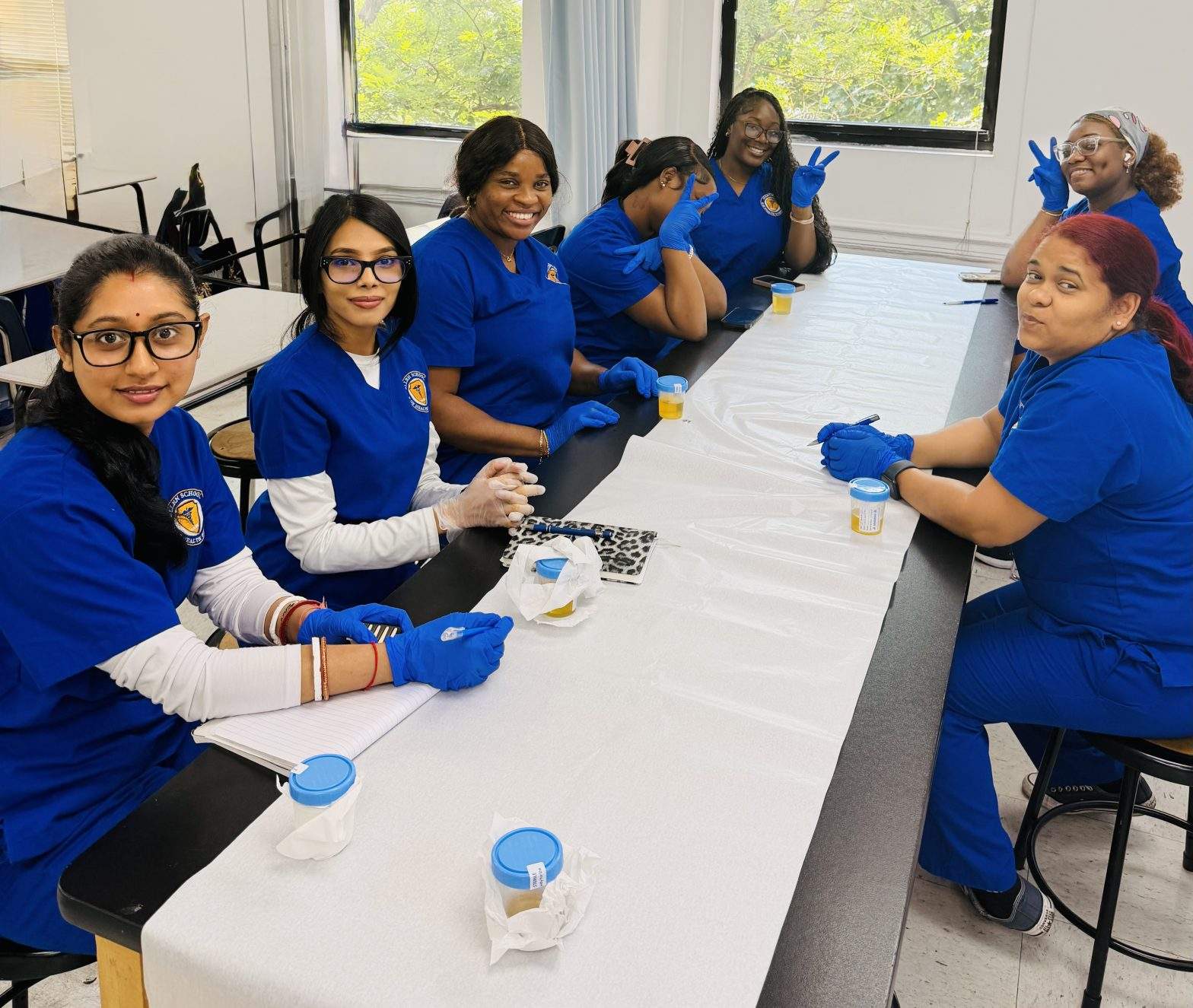
The Allen School hybrid Medical Assistant program is built differently. The curriculum emphasizes hands-on, practical training throughout — not just in a final semester capstone, but from the very beginning. And the program’s 275-hour internship component places students in real healthcare settings before they graduate, giving them:
- Direct experience working alongside healthcare professionals.
- Exposure to the daily routines and expectations of medical offices and clinics
- The confidence that comes from having already done the job before you apply for it.
- A professional reference and potential employer relationship built before graduation.
When you walk into a job interview as an Allen School graduate, you’re not just a candidate with a certificate. You’re a candidate with real experience.
5. Career-Focused Support, Not a Campus Directory
What Happens After Graduation?
At a large college or university, career services are often an office in a building somewhere on campus — one that many students never visit until their final semester, when panic sets in. The resources are broad and general, designed to serve students from every department and every major.
At the Allen School of Health Sciences, career support is specific, active, and deeply connected to the healthcare industry. The school’s career services team works with students throughout their program — not just at the end — and maintains relationships with employers in the local healthcare community.
That means graduates benefit from:
- Job placement assistance tailored to Medical Assistant roles.
- Resume and interview coaching specific to healthcare employment.
- Connections to employers who hire Allen School graduates.
- Ongoing support as you build your career.
This kind of targeted career support is one of the most underappreciated advantages of a focused trade school program. You’re not just getting an education — you’re getting a launch pad.
6. The Credential That Gets You Hired
Certification vs. Degree: What Employers Actually Want
There’s a common assumption that more education always equals better career prospects. But in healthcare, what employers care about most isn’t the length of your program — it’s whether you’re qualified, certified, and ready to work.
Medical Assistants who hold a Certified Medical Assistant (CMA) credential from the American Association of Medical Assistants (AAMA) or a Registered Medical Assistant (RMA) credential from American Medical Technologists (AMT) are recognized by employers across the country as competent, vetted professionals.
The Allen School curriculum is specifically designed to prepare students for these certification exams. That means exam prep is woven into your training — not tacked on as an afterthought. Graduates leave the program ready to sit for their certification and ready to work.
Meanwhile, a college graduate with a general healthcare administration degree may have a diploma on the wall but lack the specific clinical and administrative certifications that Medical Assistant positions require. In this field, the right credential often matters more than the most prestigious institution.
7. A Community Built for Your Success
The Allen School of Health Sciences Difference
Trade schools like Allen School aren’t just different in structure — they’re different in culture. When you’re in a program with a single, focused goal, everyone around you is working toward the same thing. That creates a uniquely supportive learning environment.
At Allen School, students benefit from:
- Small class sizes that allow instructors to know every student by name
- Faculty who brings real healthcare experience into the classroom
- A peer community of fellow students who share your goals and challenges.
- An institutional culture built entirely around healthcare career preparation.
- Ongoing support from enrollment through graduation and beyond
This kind of focused community is hard to find in a large college setting, where students are often anonymous faces in lecture halls. At Allen School, your success is personal — to you, to your instructors, and to the institution.
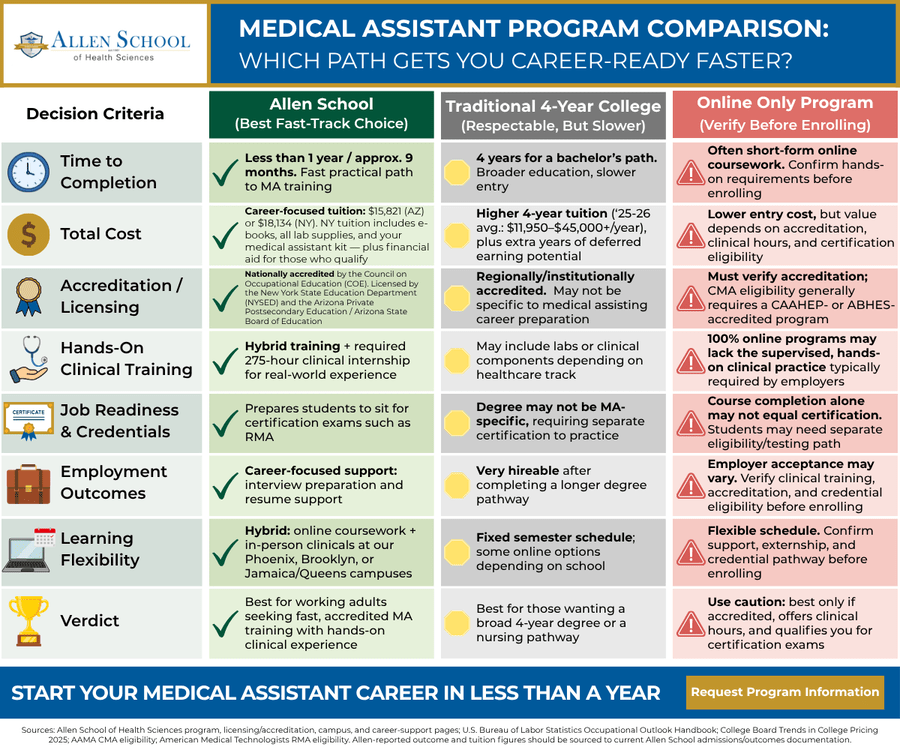
Side-by-Side Comparison
Here’s how traditional college stacks up against the Allen School Medical Assistant program across the factors that matter most to working adults building a healthcare career:
With the skills to sit for the optional CMA/RMA national certificationClass SizeLarge lecture halls commonSmall, personalized class environmentCareer ServicesGeneral campus resourcesDedicated healthcare job placement supportFlexibilityRigid semester schedulesAccelerated, focused program structure
| Category | Traditional College | Allen School MA Program |
| Time to Complete | 2–4 years (or more) | 9 months — career-ready fast |
| Average Cost | $30,000–$120,000+ | Fraction of the cost; financial aid available for those students who apply and qualify. |
| Student Debt Risk | High; average debt $37,000+ | Significantly lower debt burden |
| Focus of Study | General education + major courses | 100% healthcare career-focused training |
| Hands-On Training | Limited clinical exposure | Internships + real-world clinical practice |
| Job Readiness | Degree, but often entry-level | Certified and career-ready at graduation |
| Credential Earned | Associate or bachelor’s Degree | Certificate. |
8. Who Is This Path Right For?
The Trade School Advantage Is Not One-Size-Fits-All — But It Might Be Right for You
Traditional college is still the right choice for people pursuing careers that require a four-year degree or advanced credentials — medicine, law, engineering, and others. Nobody is disputing that.
But for people who:
- Know they want to work in healthcare and want to get started fast.
- Are concerned about the cost of education and want to minimize debt.
- Learn better through hands-on, applied training than through lectures and textbooks.
- Are working adults who can’t afford to spend four years in a traditional program.
- Want a focused, career-specific education without detours.
— the Allen School Medical Assistant program isn’t just a good option. It may be the best option.
The Bottom Line
The four-year college path made sense for a different era. Today, with tuition costs skyrocketing, student debt at crisis levels, and the healthcare industry hungry for trained professionals, there’s a smarter way forward.
The Allen School of Health Sciences Medical Assistant program offers everything you need to launch a meaningful healthcare career: focused training, hands-on experience, career placement support, and a community invested in your success — all in a fraction of the time and at a fraction of the cost of a traditional degree.
You don’t need four years. You need the right program.
Contact the Allen School of Health Sciences today to learn more about the Medical Assistant program and take the first step toward a career you’ll love.
— Allen School of Health Sciences —
Your Healthcare Career Starts Here.