
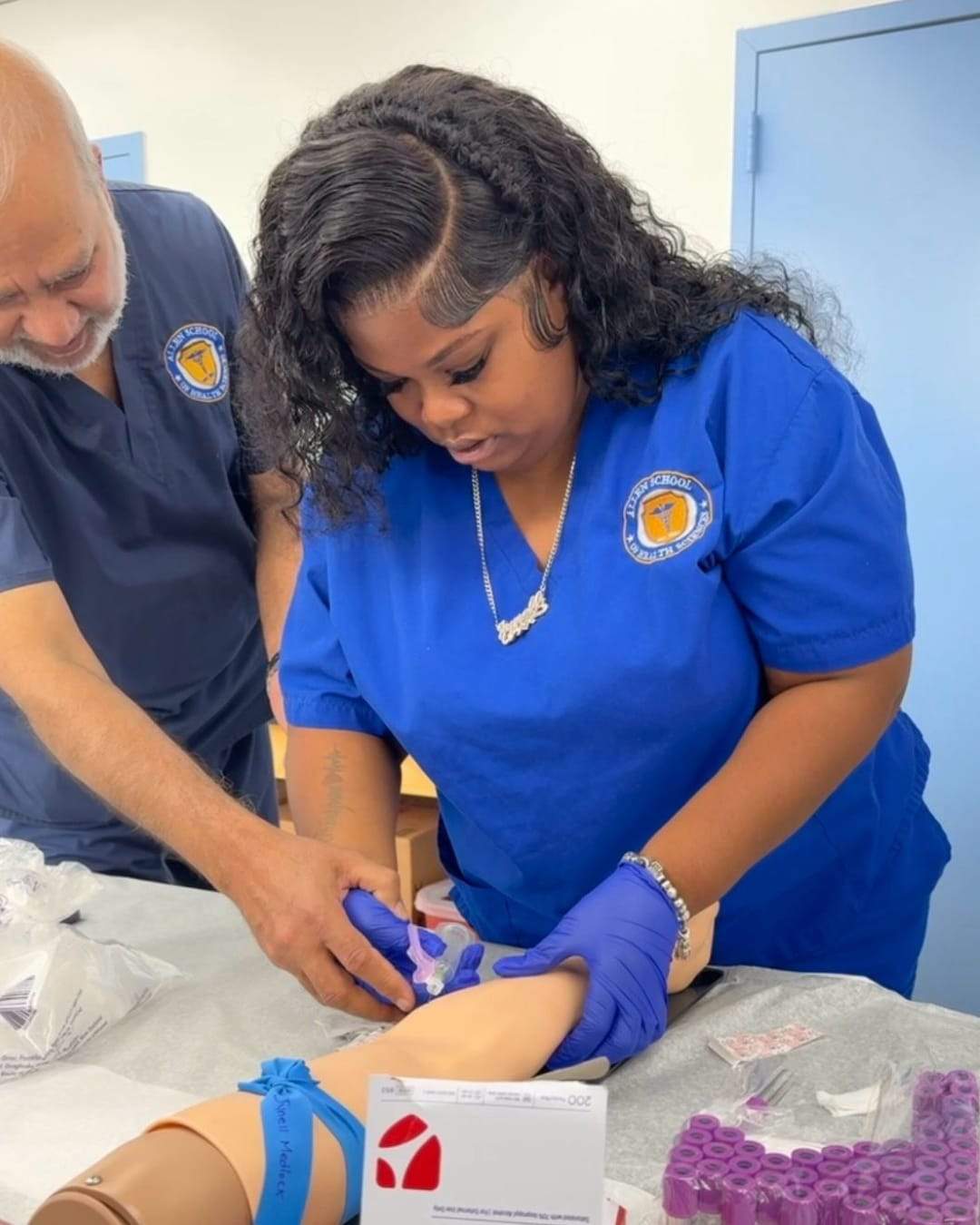
When prospective students research healthcare careers, they often wonder whether to enroll in a focused, single-skill certificate — like a standalone phlebotomy program — or commit to a broader Medical Assistant (MA) training that bundles phlebotomy within it. At Allen School of Health Sciences, we believe the answer is clear: the integrated path doesn’t just teach you to draw blood — it transforms you into a versatile, highly employable healthcare professional.
The False Economy of the Quick Certificate
A standalone phlebotomy certificate can be completed in a matter of weeks, and its short length of time is part of its appeal. But being a short program has a cost. When you earn only a phlebotomy certificate, you enter the job market with exactly one marketable clinical skill. Employers know this, and it tends to be reflected in both job availability and starting wages.
A standalone phlebotomy technician role is, in many healthcare settings, a single-function position. You collect specimens. The moment that task is outsourced, automated via newer collection technology, or simply slow on a given shift, you have limited ways to add value to your team. Contrast that with what an Allen School Medical Assistant graduate brings: a phlebotomy-competent professional who can also take vital signs, perform EKGs, assist with clinical procedures, handle patient intake, manage scheduling, process insurance authorizations, and much more.
“One credential, two worlds — clinical and administrative — and phlebotomy fluency built right in. That is what separates an Allen School MA from a single-skill technician.”
Phlebotomy in Context: Why Integration Matters
Learning to draw blood in isolation is like learning to change a tire without ever understanding how a car works. You can perform the task — but you lack the clinical reasoning that makes that task meaningful and safe.
Inside Allen School’s Medical Assistant program, phlebotomy is taught as part of a larger clinical picture. Students understand why specific lab panels are ordered, how results connect to diagnoses, and how the specimen they collect flows into the broader patient care workflow. That context makes a graduate dramatically more effective in a real clinical environment — and far more confident when something unexpected happens during a draw.
Clinical Reasoning, Not Just Technique: Allen School MA students learn phlebotomy alongside pharmacology, anatomy, clinical procedures, and patient communication — so every skill reinforces every other. The result is a professional who thinks like a clinician, not just a technician.
Side-by-Side: What Each Credential Actually Delivers
The table below shows how the two options stack up across the factors that matter most to employers and to your long-term career.
| Factor | Standalone Phlebotomy Cert | Allen School MA Program |
| Phlebotomy Training | Core focus | Fully included |
| Clinical Skills | Limited to specimen collection | Vitals, EKG, injections, wound care & more |
| Administrative Skills | Not covered | Scheduling, billing, insurance, EHR |
| Career Versatility | One role type | Clinics, hospitals, specialty practices, doctor’s offices |
| Earning Potential | Lower ceiling | Broader opportunities & higher median wages |
| Employer Demand | Narrower market | Among the fastest-growing healthcare roles |
| Foundation for Advancement | Limited pathway | Springboard to RN, PA, healthcare management |
| Clinical Reasoning Context | Technique-only focus | Integrated with anatomy, pharmacology, patient care |
Five Reasons the Allen School Approach Wins
- You graduate employer-ready across two domains at once. Allen School’s MA program prepares graduates for both the clinical and administrative sides of medical practice. Phlebotomy competency is one weapon in a full arsenal — and employers hiring MAs know they’re getting a two-for-one professional who can flex between patient care and front-office responsibilities as the day demands.
- You avoid paying twice for the same career goal. Many phlebotomy certificate graduates eventually realize they need to broaden their skills and return to school for an MA or similar program — essentially paying for two separate training programs. Enrolling in Allen School’s medical assistant program from the start means you earn phlebotomy competency as part of a comprehensive, career-anchoring credential, not as a steppingstone that requires a second step.
- Phlebotomy proficiency reinforced, not isolated. In the medical assistant program, students practice venipuncture and capillary collection alongside everything else happening in a clinical setting — patient intake, charting, diagnostic procedures. That constant cross-pollination builds muscle memory and clinical judgment simultaneously. The skill sticks better because it’s practiced in context.
- Your career ceiling is dramatically higher. A phlebotomy technician role has a relatively defined scope and salary band. A Medical Assistant with phlebotomy skills can work in physician offices, urgent care centers, specialty clinics, hospital outpatient departments, and more — and can more readily transition into supervisory roles, care coordination, or advanced clinical training. The MA credential is a launchpad; the standalone certificate is closer to a landing spot.
- Allen School’s internship gives you real phlebotomy reps in the real world. Clinical training at the Allen School includes a 275-hour internship experience as part of your medical assistant program, where students perform actual patient-facing phlebotomy — not simulated draws in a classroom, but the real thing under professional supervision. That experience is listed on your resume and is often what separates you from other new graduates in a competitive hiring process.
The Job Market Is Asking for Medical Assistants
The U.S. Bureau of Labor Statistics consistently ranks Medical Assistant among the fastest-growing occupations in the country, with employment projected to grow by 12%, significantly faster than the average for all occupations. Demand is driven by an aging population, expanded primary care access, and the ongoing shift of healthcare services from hospitals to outpatient settings — exactly the environments where Medical Assistants thrive. https://www.bls.gov/ooh/healthcare/medical-assistants.htm
Standalone phlebotomy roles do exist, and there is demand for them — but the numbers are smaller, the advancement opportunities narrower, and the long-term career trajectory more limited. When you can satisfy employer demand for phlebotomy and for everything else an MA brings, you’re simply a more attractive candidate at every hiring table.
A Credential That Grows With You
One of the most underappreciated advantages of completing a medical assistant program is what it enables next. Allen School graduates have gone on to pursue Registered Nursing (RN) pathways, health information management, medical billing and coding specializations, and healthcare administration roles. As well as taking their Registered Medical Assistant (RMA) certification. The MA credential doesn’t box you in — it opens doors.
A phlebotomy certificate, by contrast, is a narrow credential with a narrower road ahead. It can certainly support a meaningful career, but it rarely serves as the foundation for significant professional growth without additional education. Why start at a lower rung when you can start with a more expansive credential for comparable time and investment?
The Allen School Difference: At the Allen School of Health Sciences, the Medical Assistant program is designed not just to give you an opportunity to be hired — but to set you up for a career that evolves with you. Phlebotomy is part of that foundation, and the rest of the curriculum makes sure you’re never just one skill.
The Bottom Line
If you’re weighing a standalone phlebotomy certificate against Allen School’s Medical Assistant program, the decision is straightforward: the MA program teaches you everything the phlebotomy certificate does, and then some. You’ll graduate able to draw blood — and to serve patients from the moment they walk through the door to the moment they leave, handling both the clinical and administrative dimensions of modern healthcare.
In healthcare, versatility is value. Allen School’s Medical Assistant program gives you both.
Ready To Start Your Healthcare Career? Learn more about the Allen Schools Medical Assistant program and how it can launch your future in healthcare. www.allenschool.edu